What is tribal design?
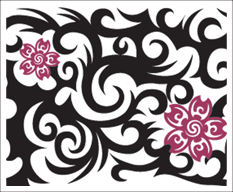
The word "tribal" means "tribal" in English. Tribal designs originally originated among tribes in the Pacific islands near the equator, such as Samoa. Samoan tribal designs are the oldest of all tribal designs. While previously referring to designs from Samoa and its surrounding areas, the term now encompasses designs used by other tribes. Some tribes, including Samoa, also use tribal designs as tattoos. While many tribal designs are simple and abstract, each has its own unique pattern and is a symbol of the culture that created them. They can also be used for fashion, social status, or to indicate marital status. While there are many different types of tribal designs, one typical example is a knife-like design with a black base and intertwined arcs. This is the design most commonly used.
The origins of tribal design
It is believed that humans first settled on the islands of Samoa around 1000 BC, approximately 3,000 years ago. The first inhabitants of Samoa are believed to have been people from what is now Southeast Asia. Later, people migrated from Samoa to Tahiti, Easter Island, Hawaii, and New Zealand. As a result, designs resembling Samoan tribal designs are common around Samoa. In ancient Tonga, tribal designs were primarily used as tattoos, and the Polynesian word tatau became the origin of the word tattoo. Women traditionally tattooed flower-like designs on their hands and legs. These designs were deeply connected to religious ceremonies and warfare, and sometimes indicated social status or what is called a family crest in Japan. Even today, some Samoan families still preserve these traditions and patterns using wild boar bones (in the past, human bones were used).
About Samoa's history
At the time, Samoan warriors wore shorts that extended from the knee to the waist, as if they were wearing shorts. In 950 AD, approximately 1,000 years ago, Samoa was invaded by the Kingdom of Tonga and came under its rule for approximately 300 years. In 1250, a Samoan rebellion occurred, expelling the Tongan and restoring sovereignty to the Samoans. Starting in the late 1700s, Europeans began to visit Samoa, and the Samoans lost sovereignty for approximately 100 years. In 1880, a dispute over Samoan kingship broke out. This conflict continued for approximately 20 years, with the indigenous peoples joining forces with three powerful nations at the time: Germany, the United States, and the United Kingdom. It was finally resolved in 1899, when Eastern Samoa was taken over by the United States and Western Samoa by Germany. Western Samoa, which was under German rule, was occupied by New Zealand forces in 1914, the year World War I began. In 1920, it became a mandated territory of New Zealand. In the same year, local Samoans began organizing activities to seek independence for Western Samoa and to work towards the establishment of an independent government. This independence movement continued until 1962, when it was officially recognized by the United Nations. Meanwhile, Eastern Samoa has remained occupied by the United States since 1899, and remains so to this day. Samoa currently has a population of approximately 180,000.







![Cherry Blossoms Every Moment ~ Cherry Blossoms Remaining ~ [Ring]](http://wargo.jp/cdn/shop/products/13753_55151ea2-0d41-454e-93ac-c246d62e293b_{width}x.jpg?v=1675845467)
![Cherry Blossoms Every Moment ~ Cherry Blossoms Remaining ~ [Ring]](http://wargo.jp/cdn/shop/products/13753_1_f709ad71-890c-442f-b1dc-3fe07427222d_{width}x.jpg?v=1675845465)
![[The Ichi(座市)]編集部のオススメ!今週の再入荷商品](http://wargo.jp/cdn/shop/collections/shopify_{width}x.jpg?v=1678940879)
![Chrysanthemum earrings (kikka earrings) [Delivery time: approximately 4 months]](http://wargo.jp/cdn/shop/products/1000200360002_{width}x.jpg?v=1678944363)
![[The Ichi(座市)]編集部のオススメ!水引細工特集](http://wargo.jp/cdn/shop/collections/Banner_Mizuhiki_{width}x.jpg?v=1685944077)
![[The Ichi(座市)]編集部のオススメ!和柄ワッペン特集](http://wargo.jp/cdn/shop/collections/Banner_Embroidered-badges_{width}x.jpg?v=1685695236)