

What is a Kanzashi?

Kanzashi is a hair ornament that decorates women's hair.
During the mid- to late Edo period, as Japanese hairstyles developed in complexity, various types of hairpins appeared and became a huge trend.
However, its origins date back even further, to the Jomon period.
Let's take a look at the history of kanzashi, which is deeply connected to the evolution of hairstyles for Japanese women.
The origin of the Kanzashi
In ancient Japan, it was believed that a single, thin, pointed stick contained magical powers, and that inserting the stick into one's hair would ward off evil spirits .
This stick, which was used more as a talisman than as a hair ornament, was called "kamizashi" and is said to be the origin of the word "kanzashi."
On the other hand, during the Heian period, there was a custom for men and women to wear flowers and branches of natural plants in their hair when attending religious ceremonies and banquets, and there is a theory that this "kazashi" (flower vase) evolved into the kanzashi (hairpin).
The description of "flower vases" also appears in the chapter "Momiji no Ka" in The Tale of Genji.
Introduction as a hair ornament - Nara period
The kanji character for "kanzashi" was brought over from China.
During the Nara period, as various cultures flowed in from China, the prototypes of modern combs, such as the long, horizontal hikigushi comb and the two-pronged hair clip called saishi, were introduced. These were written in Chinese as "kanzashi" and pronounced as "kanzashi."
In addition, in China at that time, it was customary for both men and women to wear topknots, and this culture of hair styling (called "yuigami" or "keppatsu") was also imported to Japan, with both men and women in Japan at the time wearing topknots.
However, during the Heian period, loose hair, called tarekami or suihatsu, became popular, and hair ornaments such as kanzashi (hairpins) and combs became unnecessary and fell into decline.
The emergence of Japanese hairstyles ~Azuchi-Momoyama period~
During the Azuchi-Momoyama period, Japanese women's hairstyles, which had long been dominated by hanging hair, underwent a major change, returning to tied hair.
It is said that the trend began when Izumo no Okuni, a beautiful woman who dressed as a man and performed Kabuki, started tying her topknot in imitation of young men.
Although women of high social status continued to wear their hair hanging down, common people began to wear their hair in functional styles such as "kagegami," in which the hanging hair was tied up like a ponytail so that it would not get in the way when working, and "karawa," which was introduced from China and in which the hair was rolled up like a bun on the top of the head.
The term "Japanese hairstyle" as used today in the narrow sense is a hairstyle that developed uniquely in Japan, based on this Karawa style.
The rise of Japanese hairpins (kanzashi) in the Edo period

During the Edo period, various elaborate hairstyles such as the Shimada hairstyle and the Katsuyama hairstyle appeared.
The Takashimada hairstyle, which is still known today as a hairstyle for brides to hide their tsunokakushi, is a variation of the Shimada hairstyle.
Riding on the popularity of topknots, hairpins (kanzashi) also began to see the light of day again.
In the early Edo period, "petal kanzashi" (hairpins) with a flower petal motif were made in Kyoto, and these were brought to Edo, where "tsumami kanzashi" (hairpins) appeared.
From the mid-Edo period onwards, as topknots became increasingly complex and ornate, a wide variety of kanzashi hairpins came to be made, with various shapes such as slim, wide and oval, decorative methods such as lacquer, maki-e, mother-of-pearl, inlay and openwork, and materials such as ivory, tortoiseshell, horse claw, gold and silver being used.
From the samurai class to the common people, hairpins became a fashion necessity for women.
In the 1700s, hairpins with ear picks attached to the end appeared, which are still seen in some styles today.
There is a theory that earpicks were actually used as practical items, but on the other hand, it is also said that at a time when edicts banning luxury goods were frequently issued, attaching earpicks to hairpins was a way to avoid restrictions on luxury goods.
It reached its peak at the end of the Edo period, when various types of hair ornaments, such as flat hair ornaments, tama kanzashi, hana kanzashi, and birabira kanzashi, which were made by artisans specializing in hair ornaments and utilising the finest techniques, became popular.
Additionally, the courtesans who were fashion leaders at the time were particularly fond of hairpins, and an extravagant style in which three or four were worn on each side of the head became popular.
The decline and revival of the Kanzashi (hairpin) - from the Meiji period to the present
As Westernization rapidly progressed during the Meiji period, hairstyles also changed from Japanese to Western styles, and as a result, the culture of wearing hair ornaments also declined, with the exception of certain areas such as the entertainment district.
However, in recent years, people have rediscovered the ease and functionality of being able to style their hair with just one kanzashi, and with the emergence of kanzashi with free-form designs that are not bound by tradition, they have made a comeback as a hair accessory that can be worn with both Japanese and Western clothing.

Other popular articles you might want to read:
-

How to tie your obi to stand out from the crowd! & Easy tips for tying it!
-

Popular retro-modern patterns stand out with the color of your yukata!
-
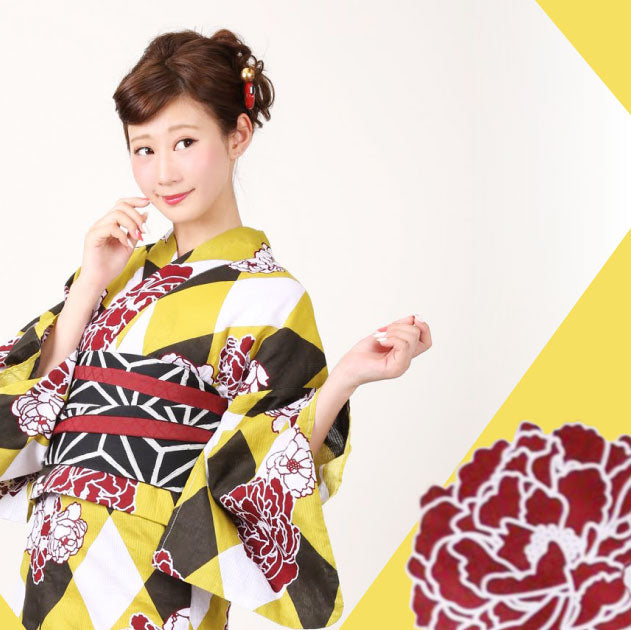
Stays put and is easy to walk in♪ A little trick for yukata
-

How to choose and coordinate a yukata that won't fail you!
-

Yukata twin outfit special feature at wargo


![[The Ichi(座市)]編集部のオススメ!今週の再入荷商品](http://wargo.jp/cdn/shop/collections/shopify_{width}x.jpg?v=1678940879)


![[The Ichi(座市)]編集部のオススメ!とんぼ玉特集](http://wargo.jp/cdn/shop/collections/Banner-kanzashi_{width}x.jpg?v=1687224735)

![[The Ichi(座市)]編集部のオススメ!水引細工特集](http://wargo.jp/cdn/shop/collections/Banner_Mizuhiki_{width}x.jpg?v=1685944077)